|
1)
Secure the fork "sideways" in the work stand and place the
hook of the ratcheting portion of a two-piece tie-down in the top of the steerer tube. (NOTE:
this may not be possible depending on the length of the hook and the depth of the star-fanged nut in the steer tube.
You may have to improvise based on your particular situation). Wrap the strap around the stand so that
the ratcheting mechanism ends up high and out of the way:
2)
The hook of the second part of the tie down strap is also placed in
the steerer tube. (Again, this may not be possible depending on the length of the hook and the
depth of the star-fanged nut in the steer tube. You may have to put a short piece of larger diameter pipe over the steer
tube, or secure the hook in some other way). Take the plain end of the strap and "thread" it under
the fork arch and up through the "slot" of the ratcheting mechanism:
3)
Screw the fork's "pre-load" knob all the way down for maximum compression
and ratchet the strap until the fork is compressed:
PLACE A BUCKET UNDERNEATH THE FORK AS BE PREPARED FOR OIL DURING
ANY OF THE NEXT FEW STEPS. Use a 10mm open-end or socket wrench to loosen and completely remove both bottom fixing nuts. Pick
the black nylon crush washers out of the fixing nuts (if the crush washers do not come off with the fixing nuts, wind them
off of the threaded shafts by hand):
Thread the fixing
nuts (less crush washers) back on to the threaded shaft ends, leaving several threads exposed, as pictured:
USE CAUTION DURING THIS NEXT STEP, AS THE FORK WILL RAPIDLY
EXTEND. Release the tension on the ratcheting strap (be prepared for oil):
Using a 26mm 6-point socket, loosen both top caps completely,
removing the preload cap and any spacers from the left side (from rider's perspective). The top cap of the damper (right)
side is attached to the damper assembly and will not be removed--just be certain that it is completely unthreaded:
WITH OIL COLLECTION BUCKET
IN PLACE, use a plastic-faced mallet (or improvise) and tap the fixing nuts sharply, loosening the shafts as they are driven
up into the legs:
When the formerly exposed
threads "disappear," you will know that the shafts have "broken free":
Since you have already
removed the left side top cap, you can easily push the plunger shaft up into the leg to allow any remaining oil to drain:
Remove the spring from the left leg (and spacers, if not previously
removed):
Remove the damper assembly from the right leg and place it
in the oil collection bucket:
The damper assembly contains quite a bit of oil. To
remove it, the damper must be properly "vented" and drained. To start this procedure, use a 12mm cone wrench to secure
the lower part of the top cap assembly, as pictured:
Securing the lower part
of the assembly with the 12mm cone wrench, use a 26mm socket wrench to loosen the upper part of the top cap
one turn. This will allow air into the damper when you drain it in the next step (note: 2005
and newer dampers have larger wrench "flats," allowing the use of a standard 12mm wrench):
Insert a small Allen wrench (or similar) into one of the five
base valve ports while holding the assembly over the bucket. Oil should run freely from the bottom of the assembly.
Pump the rod a few times to be sure the all of the oil has been removed:
Be sure and re-tighten
the upper top cap connection. Recommended torque is 75 Inch Pounds. (Be careful--overtightening
could break it and ruin your day!):
Slide the lower assembly off of the stanchion tubes:
The plunger shaft will
remain in the bottom of the left stanchion:
Remove the plunger shaft
by inverting the steerer/crown/stanchion assembly and catching it as it falls out:
Wrap the shaft of a flat-bladed
screwdriver with electrical tape, or use a rubber or cloth pad on top of the lowers to protect them from being scratched (for
clarity, a pad is not pictured). Insert the blade of the screwdriver below the Fox wiper/seal base, and slowly pry upwards:
Take care to avoid scratching the metal at the back of the lowers
with the screwdriver as the wiper/seal "pops" out:
Remove the foam ring (you may save this or use the new ones supplied
with your seal kit):
If the inside of the lower assembly is dirty, clean the inside of
the legs with a biodegradable degreaser and dry thoroughly.
(Repeat steps 20-22 for the other side)
Lubricate the seating
area for the new seal with Super-Slick Grease. NOTE: The seal insertion area of the lowers is not machined all the way down
to the bushings (The black area above the bushing is not machined). The foam rings will go past this unmachined area and sit
directly on top of the bushing. The new inner oil seals will pressed into the seal head until they sit on top of the foam
rings. Lastly, the wipers will be pressed in until they are flush with the top of the lower casting.
Place the new foam ring on top of the bushing.
Lubricate one of the new inner oil seals with Super-Slick
Grease (notice the letter side is facing up, the grooved side facing down):
Start the new seal into
the top of the lower assembly. It is very important that the seal is started evenly so that it can be pressed down without
distorting it:
Use a seal press or an
inverted socket (as pictured) to seat the oil seal against the foam ring:
Lubricate the insertion
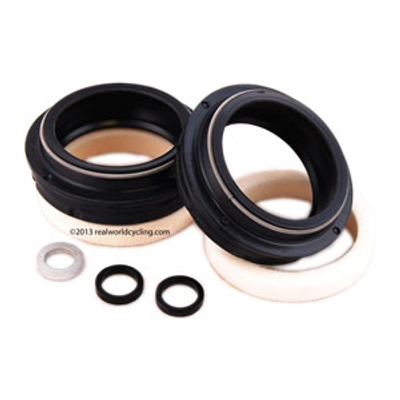
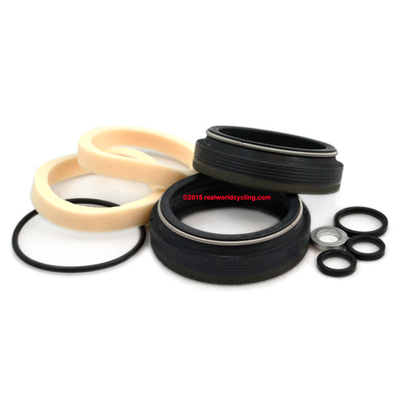
area of one of the new Enduro wipers:
Start the wiper into the
seal head. You may be able to fully seat the wiper into the seal head by hand. If not, use a short piece of PVC
pipe (or similar) to press the wiper into the seal head:
Grease the inside of
the oil seal and wiper using Super-Slick Grease (or similar). Push the foam ring to the outer circumference of the leg,
so that it does not protrude past the inner diameter of the oil seal. This will prevent the stanchion from "catching"
the foam ring when the fork is re-assembled:
(Repeat steps 23-30 for the other side)
If you want to make any changes to the fork travel
setting, now would be the time... Pictured below is the spacer configuration for 125mm travel.
(TRAVEL CHANGES FOR LONGER TRAVEL FORKS WILL USE
THE SAME PROCEDURE, BUT THE INCREMENTS OF TRAVEL CHANGE WILL BE DIFFERENT)
The damper assembly (far left) has a 25mm and a 20mm
spacer on it. The spring stack (center) has a 20mm and 25mm spacer that will be installed on top of the coil
spring. The plunger shaft (right) has no spacers for the 125mm setting:
Pictured below is the spacer configuration for 100mm
travel. The damper assembly (far left) has one 20mm spacer on it. The spring stack (center) has a 20mm spacer
that will be installed on top of the coil spring. The plunger shaft (right) has one 25mm spacer for the 100mm setting:
Pictured below is the spacer configuration for 80mm travel.
The damper assembly (far left) has no spacer on it. The spring stack (center) has no spacers that will
be installed on top of the coil spring. The plunger shaft (right) has one 25mm and one 20mm spacer for the 80mm
setting:
Drop the
plunger shaft back into place inside the left stanchion tube:
Start the lowers onto
the stanchion tubes one leg at a time, being careful to slowly work each wiper lip onto its respective stanchion. Once
started, slide the lowers up into normal riding position (approximately):
Use a small
screwdriver to guide the threads of the plunger shaft through the hole in the bottom of the lowers:
Drop the
coil spring, followed by whatever spacers you are using (depending on desired travel) into the left leg:
Hand tighten the pre-load
top cap:
Insert the damper assembly into the right leg of the fork, with
the threaded rod end through the hole in the bottom of the fork leg:
Hand-tighten the top
cap of the damper assembly:
Set up the ratcheting
strap (or alternate method of your choice) to compress the fork. Again, this is necessary because the rods tend to spin
around when one attempts to tighten the fixing nuts. (If you have cut screwdriver slots into the bottoms of the threaded rods,
then they can be held in place while the nuts are tightened and the fork will not need to be compressed):
Use a new crush washer
(supplied with your Enduro Seal Kit). Re-using the old crush washers may contribute to mis-alignment of the rods,
due to the tight fit:
Tighten the bottom fixing
nuts by hand:
Torque both bottom fixing nuts about 50 Inch
Pounds:
If you are using the "ratcheting strap method" to keep
the rods from spinning, carefully release it. On the damper side, loosen the top cap (the top caps were
only hand-tightened previously). On the spring side, remove the top cap and any spacers used. Compress the fork
so that the top of the damper assembly spring sticks out above the crown. Slowly add 155cc of Fork Fluid into
the damper leg (right side from rider's view), while periodically cycling the damper. After injecting the fluid, extend
and compress the fork a couple of times. Using the 26mm 6-point socket and a torque wrench, tighten the DAMPER top cap
to about 150 Inch pounds:
Recommended fluids are:
Fox 100% Synthetic Suspension Fluid
Maxima Racing Fork Fluid
Golden Spectro
Silkolene
On the spring side (with
the top cap and spacers still removed), add 30cc of the Fork Fluid. Re-install the spacers and top cap.
Tighten the top cap to approximately 150 Inch Pounds.
You may now proceed to your favorite riding area....
CLICK FOR "WIPER CARE" INSTRUCTIONS
|